


.png&w=3840&q=75)
This website stores cookies on your computer. These cookies are used to improve your website experience and provide more personalized services to you, both on this website and through other media. To find out more about the cookies we use, see our privacy policy.
Platforms Engineered forVelocity and Control
We design, build, and operate cloud platforms that give your engineering teams a fast, secure, and repeatable path to production. Landing zones, Kubernetes, infrastructure as code, and developer platforms, delivered as one coherent foundation.
Our Approach
Engineering discipline, applied to the platform itself.
A cloud platform is a product with users, reliability targets, and a lifecycle. We build it that way: architected deliberately, automated end to end, and measured against the outcomes your teams and your business care about.
Architect the Foundation
We define the account structure, network topology, identity model, and guardrails that everything else rests on, so growth never forces a rebuild.

Automate by Default
Every resource, policy, and pipeline is versioned code. Environments are reproducible, changes are auditable, and configuration drift is eliminated.

Enable Your Developers
Self-service golden paths and reusable templates remove ticket queues and shorten the road from commit to production.

Operate and Evolve
SRE practices, observability, and FinOps controls keep the platform reliable, secure, and cost-efficient as demand changes.

Our Services
Cloud Platform Engineering Services
A complete engineering capability for the platform your business runs on.
Cloud Platform Engineering
A complete engineering capability for the platform your business runs on.
5 platformsCloud Architecture and Landing Zones
Landing ZonesEstablish a secure, scalable foundation on AWS, Azure, or Google Cloud. Multi-account structure, network design, identity, and governance controls are in place before the first workload lands.
Infrastructure as Code and Automation
IaC & AutomationProvision and manage every environment through code using tools such as Terraform, Bicep, or Pulumi. Gain consistent, repeatable, and fully auditable infrastructure.
Kubernetes and Container Platforms
Containers & K8sRun production-grade clusters on EKS, AKS, or GKE with hardened configuration and intelligent autoscaling. Deploy containerized workloads with resilience and portability.
CI/CD and Release Engineering
Release EngineeringAutomate build, test, and deployment with quality and security gates built into every pipeline. Release faster while lowering change failure rates.
Internal Developer Platforms
Developer PlatformsGive teams self-service environments, golden paths, and a unified developer portal. Reduce onboarding time and cognitive load while keeping standards consistent.
Ready to Engineer Your Cloud Platform?
Design, build, and operate a secure, scalable foundation tailored to your business.
Our Operation Process: From Foundation to Continuous Evolution
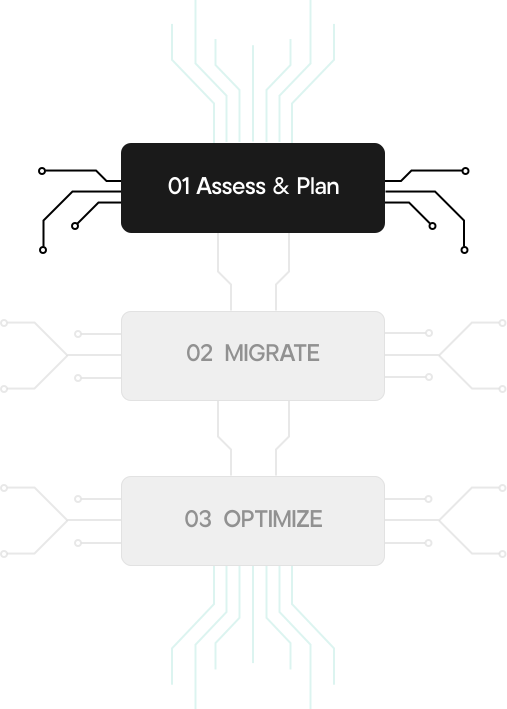
01
Architecture & Landing Zone
1.1. Estate discovery, dependency mapping, and landing-zone blueprint.
We evaluate your engineering workflows, security requirements, and target cloud environments. Then we architect the multi-account structure, identity federation, and core networking baselines so growth never forces a redesign.
Duration: 2-3 weeks
1.2. Infrastructure as Code scaffolding and automated guardrails.
We codify baseline environments using Terraform, Pulumi, or Bicep. Security guardrails and compliance policies are built directly into code, eliminating configuration drift and manual provisioning.
Duration: 3-4 weeks
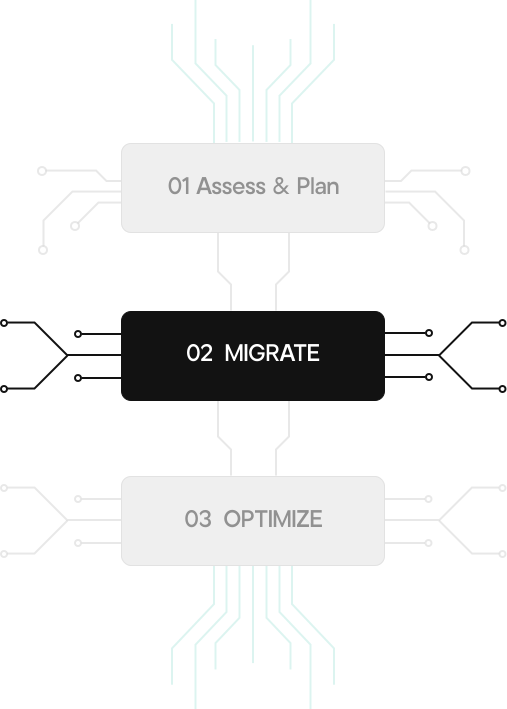
02
Platform Automation & Delivery
Kubernetes container platforms, CI/CD pipelines, and developer golden paths.
We configure resilient Kubernetes clusters (EKS, AKS, or GKE) with hardened configuration and autoscaling. Automated CI/CD pipelines with integrated security gates and self-service templates enable continuous, safe releases.
Duration: 6-10 weeks
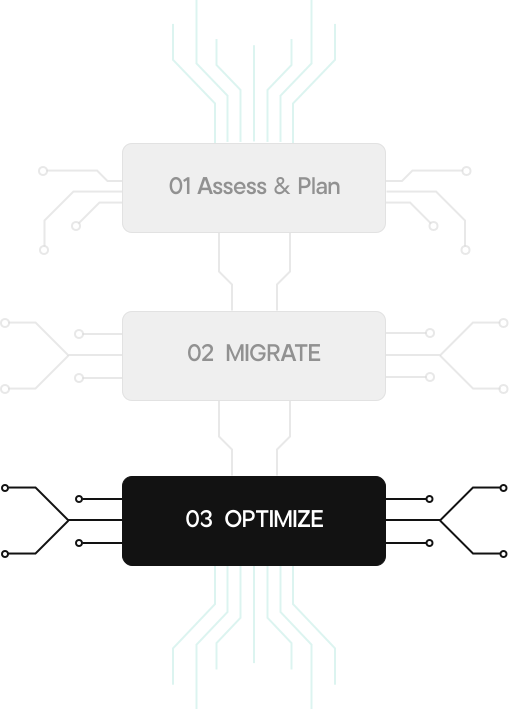
03
Operate, Evolve & Optimize
Unified observability, SRE practices, and FinOps cost governance.
We implement comprehensive metrics, logging, tracing, and autoscaling calibration alongside FinOps controls, keeping your cloud platform secure, resilient, and cost-efficient as demand evolves.
Duration: Ongoing
Our Partners
Built on Leading Cloud Ecosystems
We engineer across the major cloud and cloud-native technologies, applying vendor best practices to every platform we deliver.
01 / GCP

Advanced Tier Partner
Google Cloud
As an AWS partner, we apply proven best practices for secure, high-performing, cost-efficient architectures. AWS programs and tooling help us modernize faster and cut operational overhead.
- GKE & Anthos
- BigQuery & Looker
- Cloud Run
- Apigee Integration
02 / Azure

Solutions Partner
Microsoft Azure
Our Microsoft partnership unlocks Azure best practices, optimization frameworks, licensing benefits, and adoption programs. You transform faster and keep financial control.
- AKS & Arc
- Landing Zones
- Azure DevOps
- Synapse & Fabric
03 / AWS

Advanced Tier Partner
Amazon Web Services
Deep expertise in Google Cloud's native services, cost governance, and security controls lets you standardize operations and optimize consistently across distributed environments.
- EKS & Fargate
- Migration Hub
- Well-Architected
- Control Tower

01. BLOG
How Automation Can Reduce Administrative Work Across Departments
Automate repetitive administrative tasks, improve workflow efficiency, reduce errors, and boost productivity across HR, finance, sales, and operations.
READ MOREInterested In Learning More?
You can find relevant information about our company and services by browsing through the following FAQs. Please get in touch with us for more details.
01
What is cloud platform engineering?
Cloud platform engineering is the discipline of designing, building, and operating the shared cloud foundation that application teams deploy on. It combines cloud architecture, infrastructure as code, CI/CD, security, and observability into a standardized platform, so developers ship faster while the business maintains reliability, security, and cost control.
02
How is platform engineering different from DevOps?
DevOps is a culture and set of practices that unites development and operations. Platform engineering puts those practices to work by building an internal product, the platform, that offers self-service tools and proven paths to production. The result is DevOps at scale, with consistent standards, less duplicated effort, and lower cognitive load for developers.
03
What is an internal developer platform?
An internal developer platform (IDP) is a self-service layer that lets developers provision environments, deploy applications, and access tooling without waiting on operations teams. It packages approved infrastructure, pipelines, and security controls into reusable templates, which shortens onboarding and increases deployment frequency.
04
What services does a cloud platform engineering company provide?
A cloud platform engineering partner typically delivers cloud architecture and landing zones, infrastructure as code, Kubernetes and container platforms, CI/CD pipelines, internal developer platforms, security and governance automation, observability and site reliability engineering, and FinOps. Together, these form a complete, production-ready foundation.
05
What is a cloud landing zone?
A cloud landing zone is a pre-configured, secure, multi-account or multi-subscription environment that establishes networking, identity, logging, and governance baselines before workloads are deployed. Every new application inherits consistent security and compliance controls from day one.
06
Why is infrastructure as code important?
Infrastructure as code (IaC) defines cloud resources in version-controlled files instead of manual console changes. It makes environments reproducible, changes reviewable and auditable, and recovery faster, while eliminating configuration drift and reducing human error.
07
Do we need Kubernetes to build a cloud platform?
Not always. Kubernetes suits organizations running many containerized services that need portability, autoscaling, and fine-grained control. For simpler workloads, managed services such as serverless or platform-as-a-service can be more efficient. The right runtime depends on your workloads, team skills, and operating model.
08
How long does it take to build a cloud platform?
Timelines depend on scope and existing maturity. A foundational landing zone with core pipelines typically takes several weeks, while a full platform with Kubernetes, an internal developer platform, and governance automation is generally delivered in phases over several months. An incremental roadmap delivers usable value early.